The Day the AI Cold War Went Hot: GPT-5.3 vs. Claude 4.6
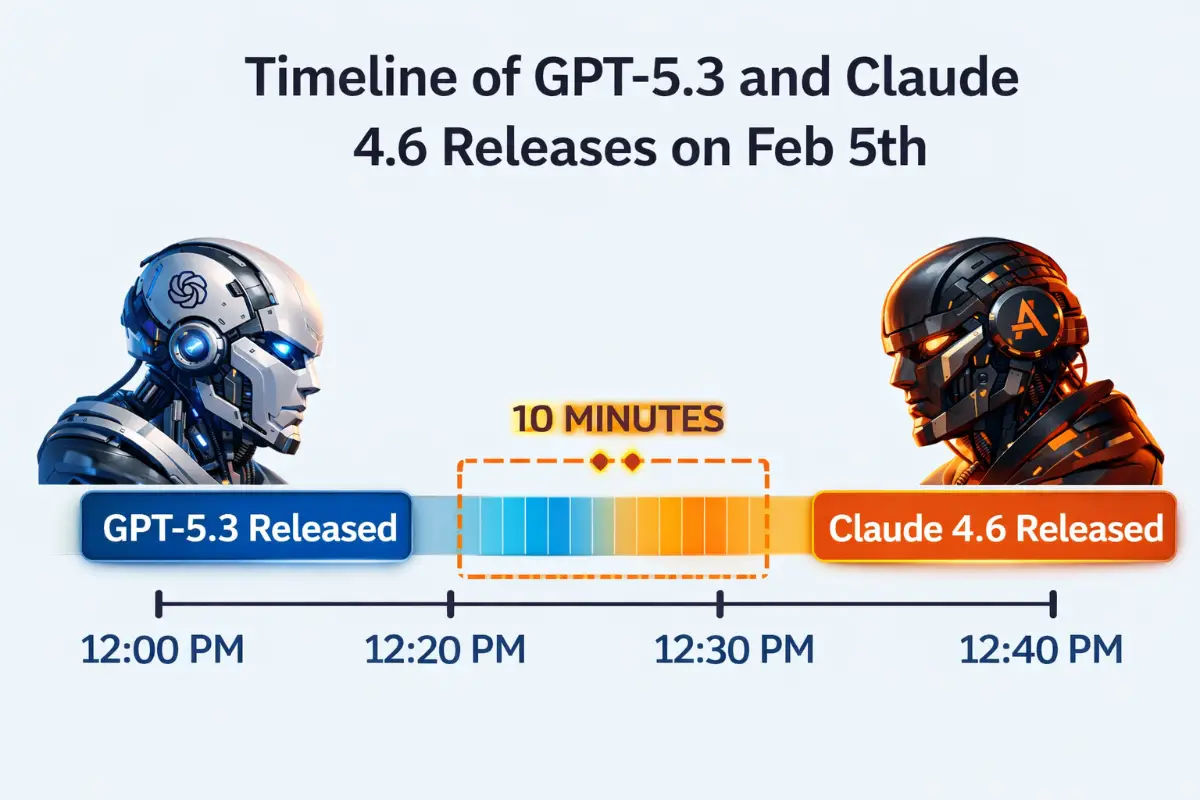
February 8, 2026 — History will remember February 5, 2026, as the day the "AI Cold War" finally turned into a direct, high-stakes duel. In a sequence of events that felt more like a choreographed thriller than a corporate product launch, OpenAI and Anthropic released their newest flagship models—GPT-5.3-Codex and Claude Opus 4.6—within a mere 10 minutes of each other.
The simultaneous drop has sent shockwaves through Silicon Valley, causing software stocks to fluctuate and leaving developers worldwide in a state of "choice paralysis." Here is everything you need to know about the two models currently fighting for the soul of the agentic era.
The 10-Minute Gap: A Strategic Masterstroke or AI Coordination?
The timing was so precise that industry insiders are still debating whether it was a case of corporate espionage, mutual pressure from shared investors, or—as some more radical theories suggest—the models themselves coordinating the release.
Regardless of the "why," the "what" is clear: we have entered the age of True Agentic AI.
OpenAI’s GPT-5.3-Codex: The Model That Built Itself
OpenAI’s latest offering isn't just a language model; it’s a "Full-Stack Developer Colleague." GPT-5.3-Codex marks a significant departure from the GPT-5.2 series, focusing heavily on autonomous execution.
Key Highlights:
- Self-Iterative Design: OpenAI revealed that GPT-5.3 is the first model to play a significant role in its own development, assisting in debugging its training code and optimizing its own infrastructure.
- 25% Speed Boost: Despite its increased complexity, it is 25% faster than version 5.2, thanks to a new unified training stack that combines Codex and GPT-5 architectures.
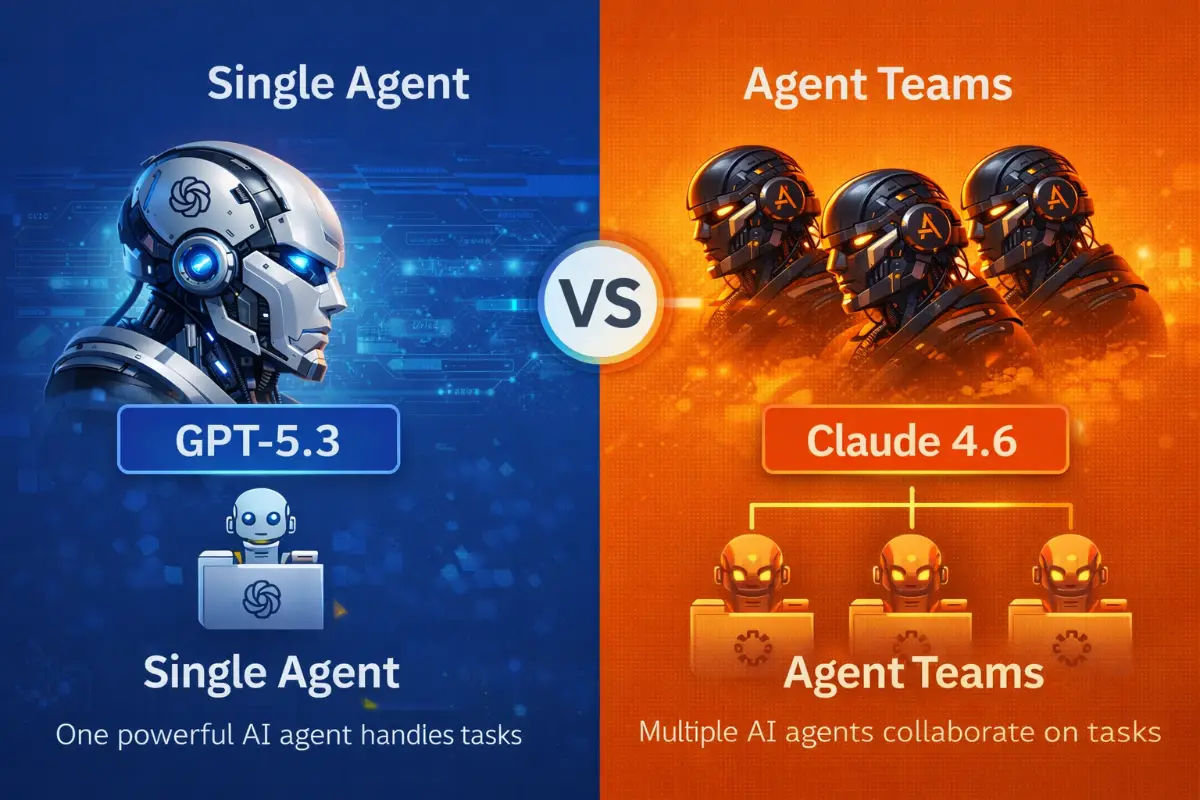
- Long-Horizon Autonomy: Unlike previous models that required constant prompting, GPT-5.3 can handle tasks lasting several days—such as building a complete, functional mobile app from scratch—with minimal human intervention.
Anthropic’s Claude Opus 4.6: The Rise of the "Agent Orchestra"
While OpenAI focused on the power of a single agent, Anthropic went for scale and precision. Claude Opus 4.6 is being hailed as the most "intelligent" model ever released for enterprise-grade security and massive data analysis.
Key Highlights:
- 1 Million Token Context Window: Claude 4.6 can now process roughly 2,500 pages of text in one go, making it the undisputed king of long-document analysis and "Needle-in-a-Haystack" retrieval.
- Agent Teams (Research Preview): Anthropic’s most innovative feature allows multiple Claude instances to work together autonomously. One "Lead Agent" assigns tasks, while others execute in parallel—essentially giving you a virtual engineering department.
- Security Superiority: In pre-release testing, Claude 4.6 discovered over 500 high-severity vulnerabilities in open-source software, proving its worth for DevSecOps.
Head-to-Head: Which One Wins?
| Feature | GPT-5.3-Codex | Claude Opus 4.6 |
|---|---|---|
| Primary Strength | Speed & End-to-End Execution | Reasoning & Massive Context |
| Killer Feature | Self-Correction & Coding Mastery | Agent Teams & 1M Context Window |
| Best For | Independent Creators & Startups | Enterprise & High-Security Industries |
| Latency | Extremely Low (Instantaneous) | Moderate (Optimized for Deep Thinking) |
The Verdict: A Fragmented Future
The "duel" hasn't resulted in a single winner. Instead, it has drawn a clear line in the sand for 2026.
If you are a solo developer looking to turn an idea into a product in 48 hours, GPT-5.3-Codex is your best friend. However, if you are an enterprise dealing with complex, multi-layered projects and thousands of pages of documentation, Claude Opus 4.6 is the superior choice.
The real winner? The users. As these two giants continue to leapfrog each other, the cost of intelligence is plummeting, and the capability of our tools is reaching heights we could only imagine a year ago.